
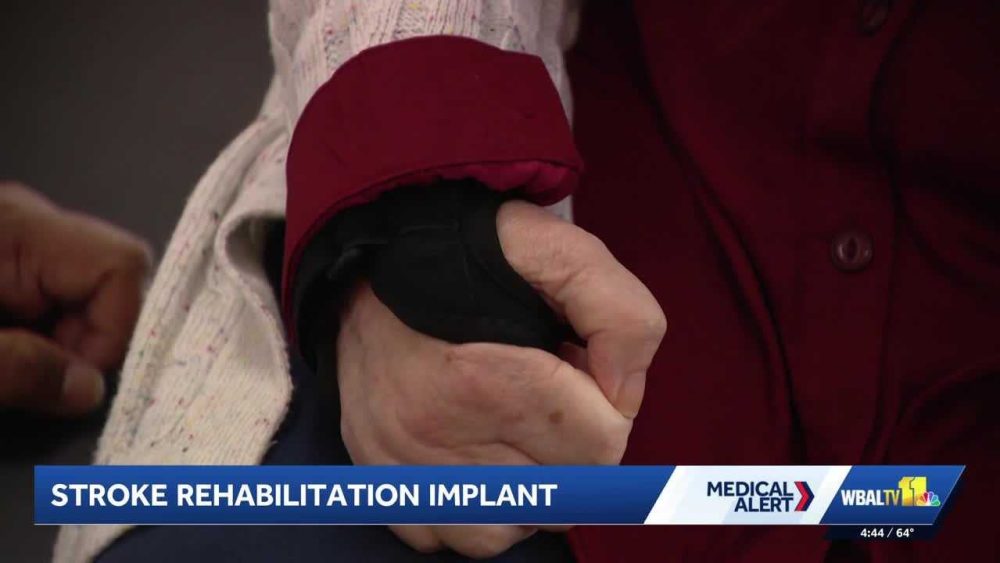
After experiencing three strokes, Linda Tanner is regaining movement in her hand through Vivistim therapy offered by the University of Maryland Medical System.
Any movement of her right arm and hand is significant to Tanner, who had her first stroke in 2022.
“I couldn’t talk, I couldn’t swallow, and I couldn’t use my leg and my arm,” Tanner said.
After extensive physical and occupational therapy following each stroke, Tanner regained her ability to speak, swallow, and use her leg.
“And some of my arm, but I didn’t have my hand,” she said.
Not satisfied with her progress, Tanner turned to the internet for solutions.
“I was looking for something to help me, help my fingers move, help (me) do daily life things. And Vivistim popped up,” she said.
Vivistim, approved by the FDA in 2021, is a device implanted under the skin during an outpatient procedure. According to the company’s website, during high-dose physical therapy, the therapist activates Vivistim, delivering a gentle pulse to the vagus nerve to improve the brain’s neuroplasticity.
“There is a capacity of the brain to create new circuits, or to strengthen the circuits, or to strengthen (those that) have been weakened. And the Vivistim, the electrical pulses — we call it neuromodulation — increase the capacity of the brain to undergo neuroplasticity. So it almost enhances the effect of therapy. It helps the brain to learn those movements that it has forgotten after the stroke,” said Dr. Krishnaj Gourab, the chief medical officer at the University of Maryland Rehabilitation and Orthopaedic Institute.
Tanner travels to the University of Maryland Rehabilitation and Orthopaedic Institute for her specialized therapy but had to go to a hospital in Delaware to have the device implanted.
Gourab said the University of Maryland Medical System is working toward providing the Vivistim implantation procedure in Baltimore.
“Recovery stops. It seems to stop after a certain time. But now, even in chronic stroke patients, we will be able to give them hope that yes, there is some recovery that is possible in movement of the arm, which is significant for some patients,” he said.
For Tanner, the treatment has been life-changing. When she turns on Vivistim, she can use her hand in ways she never thought possible.
Her goal was to pick up her grandson with two hands.
“And I did! So that was my goal,” Tanner said with a smile.
The University of Maryland Medical Center hopes to have Vivistim implantation capability by the end of the year. It is the only Baltimore hospital with therapists specially trained to work in coordination with Vivistim.
The treatment is specifically for ischemic stroke victims, and there are additional criteria for eligibility. For more information on the procedure, visit the following website.
READ MORE:Maryland stroke patient uses Vivistim therapy to regain hand movement
CHECK OUT WBAL:Get all the latest Baltimore news, weather and sports. WBAL-TV brings you the best in Maryland news online, anytime.


