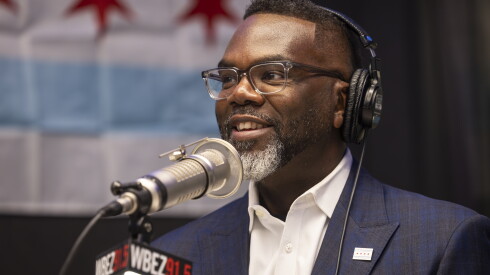
Mayor Brandon Johnson is resurrecting his failed corporate head tax and proposing his third and biggest increase yet in a tax on equipment rentals and cloud computing that is already the highest in the nation.
The $17.6 billion spending plan that will serve as Johnson’s re-election platform also seeks to nearly double the tax on sports betting, from 10.25% to 20%.
By renewing his bid to impose a corporate head tax, Johnson is defying the line in the sand drawn by the coalition of conservative and moderate Council members who rejected the head tax a year ago.
In a letter to the mayor last month, 29 alderpersons established three boundary lines for the pre-election budget debate: no property tax increase, no “head tax or tax on job growth” and no counting on money from Springfield not yet approved.
Johnson is following two out of three of those guidelines by freezing property taxes and assuming no help from the state.
But he’s setting aside the most important boundary — by triggering another bitter battle for the head tax his entrenched opposition has essentially declared “dead on arrival.”
To generate $101 million in annual revenue, Johnson’s latest version of the corporate head tax would be imposed at a rate of $25 a month per employee on businesses with more than 125 employees. That amounts to just 2.8% of registered corporations, according to the mayor’s office.
Last year’s version of the head tax was repeatedly revised and finally landed at a rate of $33 per employee on companies with more than 500 workers.
It would allow employers whose work sites are located within Chicago census tracts designated as “socio-economically disadvantaged areas” to apply for a “full rebate” of the head tax. He's also branding the per-worker levy an “Equitable Employer Tax.”
No matter what the mayor calls it, business leaders who bankrolled last year's big bucks battle over the head tax likely will characterize Johnson's measure as a job killer.
But it will at least allow the embattled mayor to connect with the progressive base of voters who helped put him in office, and say he went down fighting for a budget that requires corporations to “pay their fair share.”
“There’s greater evidence of working people being pushed out of the city of Chicago than any sort of claim of the possibility of a business leaving Chicago. Working people are being forced out of cities across America. Corporations are not,” Johnson told the Sun-Times.
“As the wealth gap between CEOs and working people continues to spread, we have to decide what’s most important. Is it protection of a tiny, tiny, less than one-tenth of a percentage? Or is it worthwhile protecting families that are paying more in gas and groceries and rent than they’ve had to pay in a lifetime?”
The city's grappling with the prospect of a $882 million budget gap for 2027. The head tax will serve as Ground Zero for that budget battle, but Johnson is relying more heavily on a personal property lease transaction tax that has turned into a cash cow for Chicago.
It’s also been one of the few business taxes that Johnson has been able to raise with minimal resistance from the business community and the coalition of opposition alderpersons that he calls the “Corporate Caucus.”
The tax applies to businesses and individuals who lease personal property, software or cloud services. That includes everything from equipment, furniture and vehicles to movies and streaming services.
To generate an additional $234 million in 2027, the PPLT would rise by a whopping 33%. The tax now imposed at a rate of 15% would increase by five full percentage points — to 20%.
To soften the blow for everyday consumers, the transaction tax on car leasing would remain 15%. Film and television crews using Chicago as a backdrop would get a break — currently 15%, it would be cut to 11% as an incentive to local productions.
“The PPLT has over-performed this year, bringing in hundreds of millions of dollars. And we remained the top destination for corporate relocation in the country,” Johnson said.
“This tax is gonna provide a lower rate for our film industry and it’s gonna keep the vehicle rate steady so people who are leasing vehicles won’t see an increase. But we are talking about these corporations that are experiencing rapid growth, with worldwide software expected to reach $1.4 trillion in 2026 alone. … We’re talking about Google, Amazon, Salesforce. These big corporations that are making hundreds of billions of dollars in terms of profit margins. What we are expecting them to do is pay their fair share.”
The mayor’s budget also seeks to nearly double the tax on sports betting.
That’s expected to generate roughly $37 million in annual revenue, but only if it survives an ongoing court challenge by the Sports Betting Alliance made up of major sportsbooks, including FanDuel and DraftKings.
“This is revenue that is generated from the companies — not the actual bettors. The additional revenue is not a direct charge to Chicagoans placing bets. It’s actually on the companies,” Johnson said.
Major sportsbooks have an ongoing lawsuit against the city, arguing the authority for regulating and taxing sports betting rests exclusively with the state.
Last year, 30 Illinois House Democrats urged the City Council to spike Johnson’s proposal to tax online sports betting, fearing it would invite other municipalities to do the same, drive online sports betting underground and send state revenue into a tailspin.
Johnson used a record $1 billion tax increment financing (TIF) surplus last year to bail out the Chicago Public Schools and bankroll a new teachers contract. This time, he’s declaring a $520 million TIF surplus with 55% of it — or $286 million — earmarked for CPS.
That will reduce to roughly $110 million the need for additional state funding assumed in the CPS budget. Without that money, mid-year cuts, furlough days or even layoffs could be needed.
To avert yet another point of political contention, the mayor’s budget will earmark $360 million for an advanced pension payment over and above the $2.79 billion statutorily required by law.
Last year, Johnson tried to cut the pension advance in half — only to restore it, delay it and ultimately make the full $260 million advanced pension payment after his City Council opponents demanded it.
To reduce packaging he called the "largest category of waste in America," Johnson wants to impose a 15-cent tax on "each non-medical and non-food container or package" in Chicago. The new tax mirrors Chicago's checkout bag tax, which Johnson claimed has "successfully altered consumer behavior" and reduced plastic waste.
The new packaging waste tax is expected to generate $9 million in annual revenue and reduce waste hauling costs.
Johnson is expected to deliver his fourth budget message to the City Council Wednesday.
After that comes two weeks of budget hearings, giving anti-administration alderpersons a forum to interrogate what has been a revolving door of city department heads.
By renewing his fight for a corporate head tax, Johnson is all but inviting another marathon budget stalemate. Finance Committee Chair Pat Dowell (3rd) said the head tax, a “non-starter” last year, is a “non-starter once again.”
Dowell was equally dismissive of Johnson’s proposal to raise the personal property lease transaction tax to 20%: “It’s doing really well. It’s a strong industry. And we should not be trying to add another tax burden to it."
Pressed to identify his fallback if the head tax is once again rejected, the mayor would say only that he would “evaluate all of our revenue options” to bankroll what he called “investments that need to be made to support working people.”
“The most important part of this budget is ensuring that we’re investing in our young people. That we’re investing in our libraries. That we’re investing in community violence intervention workers who have demonstrated that their presence drives violence down,” Johnson said. “What we do know to be a job killer is when we disinvest on the West and South Sides of Chicago.”
Last year, Johnson came under fire for borrowing $449.3 million over five years to cover “non-capital” operating expenses. That included $166 million for retroactive pay raises for Chicago firefighters that, aldermen were assured, had been set aside in previous budgets and $283.3 million for settlements tied to allegations of police abuse.
Now Johnson plans even more borrowing — $480 million over two years — to cover the newly authorized $260.8 million global settlement for 17 plaintiffs framed for murders by corrupt former Chicago police Det. Reynaldo Guevara and other police-related settlements either “expected or approved.”
“It’s a non-structural expense. It dates back to legacy harms that were done that now we, as today’s taxpayer, are accountable for although these relate to events that occurred decades in the past,” said senior mayoral adviser Jason Lee.
Last year, the alternate budget that got approved changed the way the liquor tax was applied to packaged goods consumed off site. It went from a flat tax of 1.5% to a volume-based tax, a change expected to generate an additional $6 million in annual revenue. Instead, there was a reduction in revenue of $4 million by June 30.
Now, Johnson wants to return to a flat tax on packaged liquor, but increase the rate from 2.38% to 3% to generate an additional $13.8 million in annual revenue.
Johnson also projects $6 million in new revenue from a vehicle debt amnesty program for parking, red light, speeding and compliance tickets, with another $12.8 million from the Smart Streets expansion project.
That effort uses surveillance cameras mounted on CTA buses and Chicago Department of Transportation vehicles to catch and ticket motorists parking or standing in bus and bike lanes. The City Council just renewed that program and authorized it to go citywide over the next few years.
Johnson also is using the $75 million up-front payment from Stonepeak Partners tied to the New York investment firm's $2.5 billion acquisition of Chicago parking meters to defray the cost of the $364 million advance pension payment in 2027. City Council leaders who negotiated that deal assumed the $75 million would be over and above the pension advance, and that the ongoing profit-sharing payments from Stonepeak would also be used exclusively to chip away at the city's $36 billion pension crisis.